Whitten
Artist / Painter
richardwhitten.com
https://www.instagram.com/richardwhittenart/
https://www.facebook.com/richard.whitten.5623

Galileo Project
The allure of science, with its promise of intrinsic value and incontestable benefit, captures our imagination such that we can be looking at a historical scientific instrument and admire its beauty without even knowing what it does. Within this framework, a scientific object suggests a use while it also enchants us. Sometimes it is the vague suggestion of utility that is most stimulating to the eye, more so than an actual knowledge of its purpose or scientific relevance. Our unfamiliarity with old scientific objects invites us to daydream about their meaning and entices us to admire them purely for aesthetic pleasure.
Artists Doug Bosch and Richard Whitten are both inspired by the look and function of antique scientific instruments and together they have conceived of the Galileo Project to bring the stuff of dry science textbooks to life. Colleagues and longtime admirers of one another’s work, the artists are making two distinct, yet integrated groups of work that refer to objects in the permanent collection of Museo Galileo, Florence, Italy. This museum houses a collection that has been dedicated to the History of Science for the last four hundred years. Both artists have a long history of independently using early science to inform the aesthetic and underpinnings of their artworks. Here, with the Galileo Project, they join forces to produce a coordinated body of work that examines how a painter and a sculptor meet the artistry of science head-on, treating audiences to a rare delight.
Project Statement by the Artists
The human urge to measure, define, and understand the world around us drives creativity. Artists Doug Bosch and Richard Whitten identified six inventions from the collections held at Florence’s Museo Galileo and designed their own imagined, yet plausible, contemporary versions of the originals. Their work, begun during Covid and completed last year, responds to the scientific instruments collected by generations of influential patrons between 1434 and 1859. For example, antique devices that track the stars, measure humidity, and detect electrical current become a series of manuscript-like paintings by Whitten and patent model-like sculptures by Bosch. Their creations invite us to engage our imagination around the intersection of science and design, and the ambiguous space between technology and artmaking.
Thomas Loughman, Phd, President and CEO of the Morris Museum, Morristown, NJ
The Six Instruments Chosen from the Museo Galileo Collection

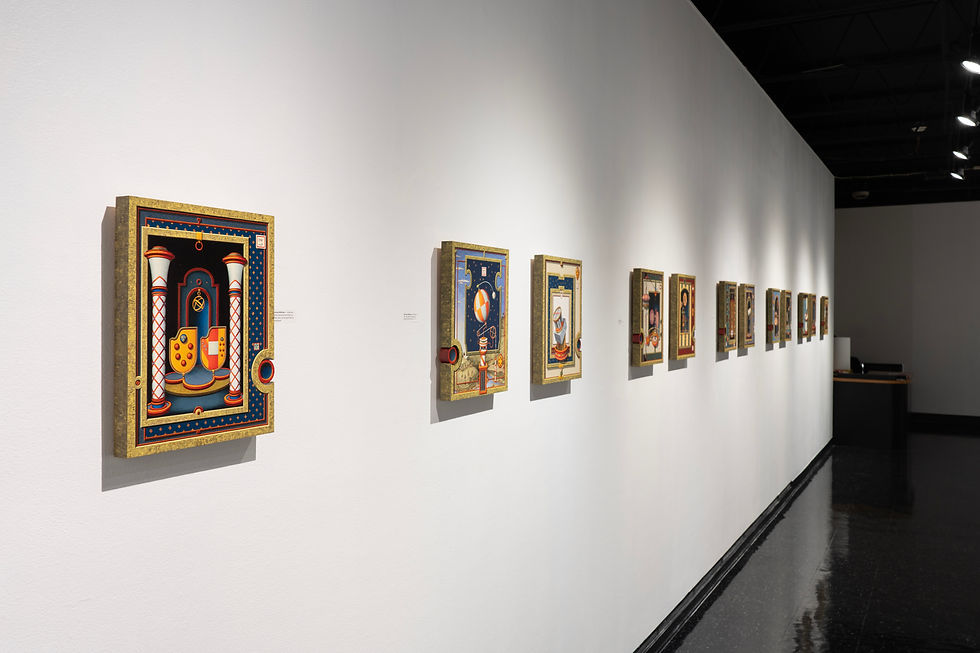
Paintings by Richard Whitten

Whitten: Individual Paintings


Whitten Preliminary Drawings


Sculptures by Doug Bosch

Bosch: Individual Sculptures


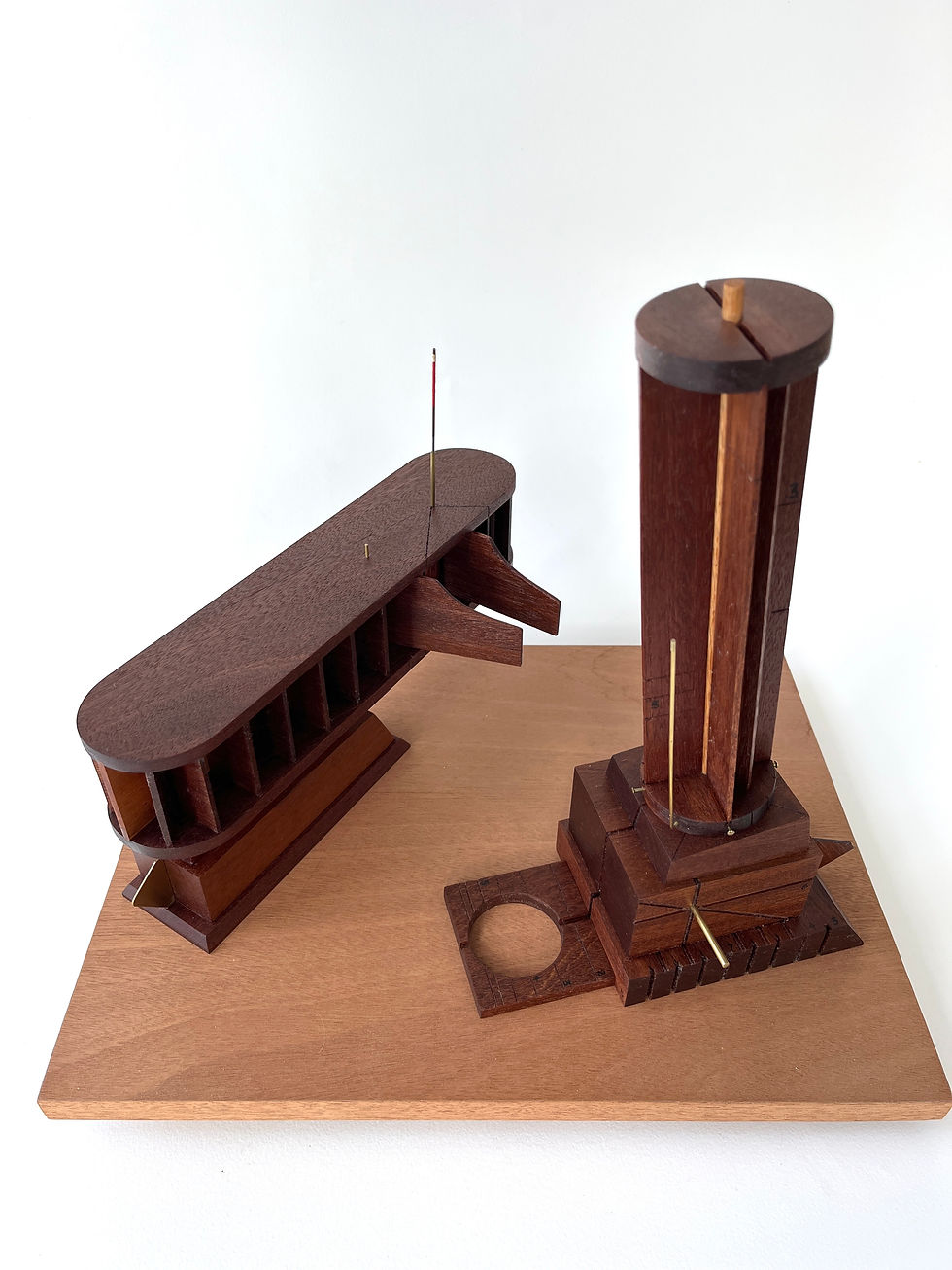
Bosch Preliminary Drawings


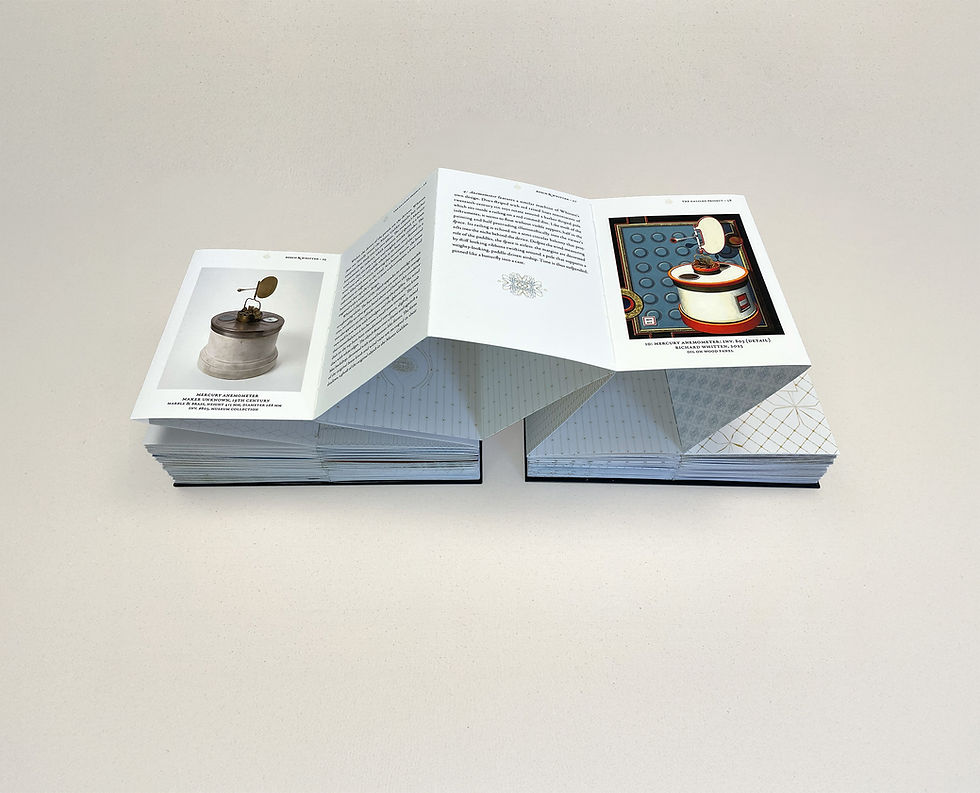
Catalog by Nancy Bockbrader




Exhibition at the Bannister Gallery, RI College



Video Walkthrough of the Bannister Exhibition
"Art of the Instrument Maker"
A lecture for the Galileo Project by Sara J. Schechner, Ph.d, the David P. Wheatland Curator Emerita of the Collection of Historical Scientific Instruments at Harvard University
Curator's Statement: Victoria Gao, Phd
Galileo is a project that has been a long time in the making, one that began over seven years ago with a conversation at the Vermont Studio Center, where Doug Bosch and Richard Whitten, colleagues in the Rhode Island College Art Department and long-time admirers of each other’s work, had adjacent studios. Both artists have a long history in their own works of drawing on scientific inspiration. Bosch frequently references 18th and 19th century scientists and scientific instruments in his own sculptures, intentionally creating objects that look as if they may have a function but that soundly resist actual utility. Whitten’s illusionistic paintings open up whole worlds of wondrous analog machines, often catching an object mid-flight or a gear mid-turn.
At the Vermont Studio center, Bosch and Whitten realized that, by coincidence, they were both looking at the same scientific instrument from the collection of the Museo Galileo in Florence, Italy. Museo Galileo is not, as one might assume, a museum dedicated to the Italian astronomer Galileo Galilei, but a museum that has been dedicated to the history of science and scientific instruments for the last four hundred years. Bosch and Whitten ultimately settled on a selection of six scientific instruments, dating from the 17th through 19th centuries, that are housed at the Museo Galileo. Most of these instruments were designed to observe – stars, air currents, electricity, humidity. As the artists describe, “the instruments were selected for their shape, materials, proportions, function, and their captivating aesthetic appeal.”
The initial goal laid out by Bosch and Whitten was to create six artworks each that directly related to each of the six selected instruments, along with an additional six artworks each that took one element from the source instrument and expanded upon it, creating a hybridized “cousin” instrument that could easily appear to fit in with the rest of the Museo Galileo collection. In the end, each artist researched, designed, and created artworks that remained true to their original goal but were imbued with the artists’ distinctive styles.
Bosch and Whitten invited fellow Rhode Island College Professor Nancy Bockbrader to create a hand-bound exhibition catalogue for the exhibition. A graphic designer and bookbinder, Bockbrader drew on the colors, textures, and analog techniques of 17th- and 18th-century Italian artists, printers, and type designers to produce the accordion-style book and accompanying clamshell case. The cover, adorned with gold foil text and images, draws a parallel to the gold and brass materials used in the scientific instruments of the Museo Galileo. In a similar act of referencing the original source materials, Bockbrader builds in a faux gauge and a hidden inner compartment for an assemblage of folded paper structures, inspired by the paper-disk hygrometer invented by John Coventry at the Museo Galileo. Bockbrader puts it simply, “These attributes connect with Bosch’s and Whitten’s work, which also uses the aesthetic qualities of scientific invention as reference for their artistry.”
Doug Bosch’s twelve sculptures began as drawings that contemplated the shape vocabulary of the source instruments from the Museo Galileo. Having visited the museum in Florence several times, Bosch also considered objects that are housed in the same room as the source instruments, drawing connections only apparent to those who have stepped into the museum itself. As he started crafting his own sculptures, he intentionally left the objects to look a little clumsy, handmade, reminding the viewer that these are objects that specifically resist utility and machine-made perfection.
The seemingly random positioning of the different components of Bosch’s sculptures, especially in Inv. 2453f (Belted & Subdivided, with Assorted Keys) and Inv. 2453.7 (Seekers), directly undermines the steady exactitude of the referenced object. The astronomical ring from the Museo Galileo consists of three concentric brass rings – one ring is inscribed with the degrees of a semi-circle, another with the names of the stars.[1] Each inscription is intentional, and each movable component serves a scientific purpose. Bosch’s grouping of astronomical rings disassembles the three rings of the reference object, multiplies them, and scatters them across a base, which is painted to be reminiscent of the way historic scientific instruments are often displayed in museums. They appear random and disordered – but not unintentionally so. Instead, they look, for the viewer, like a complex three-dimensional puzzle that is meant to be put together in the mind’s eye to re-form the astronomical ring from Museo Galileo.
Relying on the imagination and the vision of the viewer is also a key facet of Richard Whitten’s paintings. His interpretation of the project was to create an imaginary catalogue of museum objects, with each panel painstakingly painted like the page of an illuminated manuscript. The finished set of twelve paintings, each 15.5” x 12.25” – the same size as the bases of Bosch’s sculptures – form a dissected view of the catalogue, with each painting representing either a recto or verso of a page. Whitten brings in references from his own earlier paintings – a cigare volant, a tellurian – but each painting is also rich with symbolism that relates to the original scientific instruments and the Museo Galileo itself. Numerous crests can be found in the marginalia across the twelve pages, several of which contain five red balls and one blue ball and refer directly back to the Medici family, the famed rulers of Florence whose private collection of scientific instruments were the basis upon which the Museo Galileo was founded.
Invention - Invenzione: Exhibition Essay by Natasha Seaman, Phd
In 1981, when I was 12, my family drove across the country. Deep in the middle of flat, hot nowhere, we stopped at a Bob’s Big Boy, and as we waited to be seated, I inspected my surroundings. The cool air was welcome. The carpet was ugly. The cigarette machine was unremarkable. Another machine hulked next to it, incomprehensible. A little taller than me, it was made of dark metal and plastic with buttons and blinking lights. Users could insert coins, grip sensors with both hands, and receive “biofeedback” in the form of a graph on a strip of paper. The machine’s signage promised rich self-understanding that would lead to love and success.
It was, in short, nonsense. But shaped by awareness of a physical phenomenon (electrical impulses detectable on the skin), the aesthetics of then-current scientific tools (blinking lights, print outs), and desire for self-insight, it embodied a distinct moment in human existence. The objects at the Museo Galileo that so capture Doug Bosch’s and Richard Whitten’s attention are also artifacts of how people knew, made, and desired in that moment.
Not tools of hard science but rather intended for consumption by collectors, the instruments seek both to measure and to please. In their current display in a museum, untouchable behind glass, the scientific task of the instruments becomes theoretical, tasking the viewer with imagining their function all while luxuriating in their intricacy and decorative flourishes. Subject to this sort of gaze, they are like the art objects of the contemporary art world of Bosch and Whitten: visual objects, conceptualized intellectually and aesthetically, and intended for display. This is therefore not so much an art project about scientific instruments as it is a project with them.
Bosch and Whitten’s work in response to the Galileo Museum objects register most of all the acute delight they take in them, compounded of indulgent affection for past scientific endeavor and a deeply covetous appreciation of the instruments’ aesthetic. In their engagement with these objects, Bosch and Whitten’s work manifest archaism, the emulation of works of art or literature from a period distant from the time of the artist. Archaism often emerges at inflection points in history, when some aspect of the older work, now obsolete, is newly conspicuous because of the current conditions. (We might surmise that the conditions in this case relate to the current surfeit of the digital and virtual.) It acknowledges in revisiting the older work the distance we have traveled from that work’s time and registers with it a sense of loss.
Bosch and Whitten’s rapprochement of art and science relate to both the English word “invention” and the Italian term “invenzione,” as it was used in Renaissance art theory. The Italian term refers to the power of the artist to develop a subject and plan how it would be depicted; by the eighteenth century, it also included the artist’s ability to create the effect of wonder in the viewer. In English, the sense of “invention” as creating a new process or device dominates, though other meanings, such as creating a fiction, are present as well. Thus, Bosch and Whitten’s fictional objects (inventions) demonstrate their artistic power through their inauguration of the project (invenzione), based on the scientific research that led to the materialization of these objects (inventions). This rich conceptual structure is visible in both artists’ preparatory drawing and notes (invenzione) as well as in their final works of art.
Both brilliant in their conception, Bosch and Whitten approach their self-assigned tasks differently. Of course, one artist is a sculptor and the other a painter, but Whitten’s work recuperates and protects, where Bosch’s delights in the signs of decay and the poetic ruin of the aged devices.
Whitten presents his twelve works, painted on vertically-oriented rectangular wood panels, as pages from a notional manuscript. On the long side of each panel is a precise, red-bordered circle that is cut partially free from golden green frames. Painted with an illusionistic shallow depression in deep blue, these circles evoke thumb indexes and draw the paintings together as a group and, by mirroring one another as if across the pages of a book, as individual pairs. Inside each rectangle, Whitten deploys an array of additional frames, floating backdrops, and landscape backgrounds as surrounds for a niche or a plinth that contains the image of an instrument. Trompe-l’oeil labels with Whitten’s monogram and inventory numbers dot the surfaces.
In their structure, Whitten’s work draws on the complex forms of sixteenth-century Italian painted manuscripts with their frames within frames and decorative marginalia. Like the makers of those books, he is deeply engaged in how surface adornment reinforces the flatness of the picture plane and how perspective subverts it. Although the “book” is essentially deconstructed (like many an old manuscripts subjected to the art market), the paintings firm up the frailty of parchment pages and also reject a book’s serial viewing experience, allowing (obliging) the viewer to (try to) take it all in at once.
Within the device of the panels are the devices. Whitten does not literally record the Museo Galileo objects but rather interprets them freely into his own idiom. The museum’s Mercury Anemometer, for instance, which measures wind speed, is a brass wind vane that sits atop a squat and weighty marble cylinder. The wind vane and a set of paddle wheels at its base once floated in a cistern filled with mercury, allowing free movement of the central instrument in response to the wind. As bonus features, the brass horizontal that caps the cylinder is inset with a compass, a level, and engraved with a wind rose design.
Whitten’s depiction of the object upgrades its smudgy marble to a gleaming white. The base and cornice are now red with orange rims, set off by an olive-green band above and below; this combination also appears on the cylinder containing the paddles. The wind vane itself is now white with red edges, and the spherical brass knob that counterbalanced it has become a small mute trumpet. The two dials on the top have been transformed into green, slightly raised discs with white edges. The object floats over a frame and against a backdrop of blue decorated with raised button-like forms. The form of the original brass knob and wind vane are recouped in their shadows, a ghost of the original object in the Museo Galileo.
Anemometer features a similar machine of Whitten’s own design. Discs striped with red raised lines reminiscent of twentieth-century tin toys rotate around a barber-striped pole which sits inside a railing on a red-rimmed disc. Like most of the instruments, it floats without visible support, half in the painting and half protruding illusionistically into the viewer’s space. Its railing is echoed on a semi-circular balcony that projects into the niche behind the device. Despite the wind-measuring role of the paddles, the space is airless: the margins are decorated by stiff looking ribbons twisting around a pole that supports a weighty-looking, paddle-driven airship. Time is thus suspended, pinned like a butterfly into a case.
Where Whitten captures and renews, layering reference upon reference into his sleek and dense panels, Bosch explodes the objects, embracing their status as artifacts. His twelve works are presented on plinths identical in shape and size to Whitten’s panels, some painted or stained in order to evoke the décor of science museums. Where Whitten’s paintings invite the viewer to experience the objects via his own intricate world, Bosch’s sculptures infiltrate the museum, subtly reorganizing our experience of it.
The Astronomical Ring in the Museo Galileo is a simple structure: three interlocking brass rings, each inscribed minutely with the signs of the zodiac, names of the stars, zodiacal hours, and degrees. Such objects could be used as a traveling sundial (in the correct conditions) and as a representation of the solar system. Bosch’s first response deconstructs the sphere onto a robin’s-egg-blue plinth, turning it into two objects made of the same gauge and scale of brass as the original. One becomes a wobbling skeletal cylinder, pierced by vertical wires that sit on a trio of tiny wooden feet capped with velvet. Other rings have been straightened into horizontals that crisscross the central void.
Bosch’s second response obtains the spherical form that its sibling lost, but its rings are at the wrong angle to one another, one ring too small and fallen to the bottom of the structure. Another ring is replaced by a round wire, a spur from which lodges in a crossbar below it. At the bottom right is laid out an array of tiny implements which one can notionally yet nonsensically insert into one of the many holes that await them. They also seem as losable as a Barbie doll’s shoes, arranged precariously on the edge of their plinth, a jarring bump away from loss or disarray.
In Bosch’s second iteration of the astronomical ring, this nominal structure and order has come undone. Now the rings are disconnected parts, massed together as an airy pile of orphaned pieces. Each ring touches another, as if they are drawing together for safety, mounding subtly to the center. Two oar-like rods, like uselessly double-ended screwdrivers, tilt outwards from the center of the pile at an acute angle, unstable but grounding amid the wreckage of rings.
Similar disarray appears in the Hygrometer 1 and Schweiger 1, in which seemingly lost or excess elements of the original object (paper discs in Hygrometer and wire wrapped, beeswax-soaked cartridges in Schweiger) are piled together. These piles suggest preservation but abandonment to storage; disconnected from their instrument, they seem vulnerable in their obsolescence. Bosch also takes a special interest in the appearance of wires: he exploits not only the aesthetics of their malleability, but also the emotional impact of their breakability, delicate spirals twisting sadly into the air, connections severed.
Some objects nudge Bosch in a more restorative direction, however. The Museo Galileo’s Polyhedral Sundial concatenates a cylinder, a rectangular block, and a step-like structure embedded with shallow concavities (these seem to have been the inspiration for the fictive depressions on Whitten’s panels). The Sundial resembles a diminutive but heavily armored knight kneeling before us, its codpiece the blade-like gnomon. Incised with lines to divide the planes and bedazzled with numbers, the device promises multiple kinds of readings and functions.
This suggestion of multiplicity and fertility result in not two, as in Bosch’s emulation of the Astronomical Rings, but six new objects that skip from the object’s native stone into an assortment of woods. Displayed on one sky-blue plinth, the sculptures are variations on the cantilevering, the stacking, and the latent anthropomorphism of the original. In Bosch’s version, the objects have turned droll, like larval droids or chicks dashing around the mother chicken, gnomons turned beaks.
In Bosch’s next variation on the object, the sundials grow up. Now a sleek pair of two, they are a rich brown. The bowed “head” is gone, replaced by a towering vertical in one object and a dignified horizontal oblong in the other, both cross-sectioned by vane-like vertical slabs. In the oblong, the vanes suggest paddles on a mill wheel, windows on a trolley car, and the verticals of the sundial knight’s helmet. The brass wires from the Astronomical Rings make an appearance, marking the meetings of lines inscribed into the surface. The gnomon beaks emerge discreetly from their bases, now in an elegant brass.
In their varied responses, Bosch and Whitten invite comparison, for which there is another useful Italian Renaissance term: paragone. Artists and critics applied the word especially to the competition between sculpture and painting. Partisans of each media argued for their superiority on a range of criteria such as working conditions: painters could work in their best clothes while listening to a lute player, whereas sculptors were always caked with stone dust and couldn’t hear anything over the din of their tools; or completeness: sculptors could render an entire figure, while painters could only depict one side of their subject. Bosch and Whitten eschew the competitive snark but invite the comparative gaze: viewers can compare the artworks with the originals, and Bosch’s interpretations with Whitten’s, and sculpture’s capacities with that of painting.
Of course, as much as the artists differ in their approach, there are convergences. Both adopt the numbers found on the objects, such as on the Polyhedral Sundial. These are elegantly calligraphed with razor sharp serifs and placed inscrutably yet purposefully around the object in relation to vertical scorings in the stone. Whitten reproduces these numbers fairly faithfully but drops some, most notably the ones on the top of the cylinder, and conceals others with a red fence around the base. Bosch subtly tools numbers into the surface of his wooden sculptures (and on the brass Astronomical Rings), a treat for careful looking. In their inclusion of the numbers as decoration and allusion rather than calculation and measurement, the artists transform the highly meaningful numeration of the original instruments, underlining their metamorphosis into artifacts.
Both also succumb to the allure of gold. Gold leaf, created in the Renaissance by beating pure gold coins into whisper-thin sheets to be applied to the surface of paintings, created the illusion of solid gold surfaces, backdrops to depictions of Christ and the Virgin Mary. As pictorial naturalism became more valued than material opulence, gold leaf retreated to decorative details in the painting and onto frames. Gold is a decorative flourish that appears on the cornices of the Polyhedral Sundial, a limited context that Bosch and especially Whitten maximize in their work.
Bosch conflates Sundial’s gold leaf decoration with its numbers, embedding gold paint into some of the digits tooled into the surface. This subverts the typical application of gold in sculpture, where it is usually applied to relief elements or to the entire object to mimic a gold object. The gold paint here suggests decorative bookbinding, calling back to the knowledge-seeking purpose of the scientific instruments and converging with Whitten’s panels.
Whitten uses gold leaf in his depictions of the two galvanometers, used for measuring electric currents (and thus an ancestor, no doubt, of my biofeedback machine). The Oersted Multiplier, spiffed up in festive white and red, floats in front of a gold leaf panel that hangs in front of a black abyss. This functions like a religious niche, the galvanometer a spindly Virgin and Child, the gold warm and softly reflective. The Galvanometer protrudes from a fictive gold-and-copper-leaf checkerboard frame that seems to pulsate, a subtle reminder of gold’s electrical conductivity.
Both also integrate self-reference as a means of retaining their authorial presence in their responses, folding the scientific instruments into their existing work. They came to the project through their shared interest in the devices, which relates to their own artistic agendas. Bosch’s previous work explores bundles and stacks and non-functional machine-like objects, many of them made through lab-inflected processes and materials. The paper stacks in the Hygrometer 1 and 2, for instance, have long been a motif in Bosch’s art. Whitten’s work frequently depicts fictional machines, like dirigibles and paddles, and the motif of a disembodied eye floating inside a circle recurs here as it does in previous art.
Based on this, one might say that Bosch and Whitten have been working on the Galileo Project all their artistic lives. But the shared endeavor sharpens the focus and provides a playing field for their exploration – much like that inhabited by the networks of scientists (and artists) from the Renaissance and beyond – as they worked to understand and represent the world. The discovery here is less about the external world and more about how we materialize our responses to it, especially for the delectation of others. Like my Bob’s Big Boy biofeedback machine, we can look to the works for self-knowledge as well as basking in the aura of scientific discovery.
Created to both accompany and catalog Bosch and Whitten’s works, Nancy Bockbrader’s artist’s book similarly revisits yet updates the materials, craftsmanship, and formats of the past. Highly technically complex, the book pays homage to the decorative excesses of the original devices and the intricacy of the artworks that respond to them. A self-supporting accordion structure that unfolds to a length of over 10 feet, the book can both open like a typical codex and undulate across the long exhibition table constructed by the sculptor Kirsten Warnock. In the latter mode, the book transcends the limitations of a normal book, allowing, like Whitten’s paintings, simultaneous viewing of multiple pages. Closed, the book can be placed in its bespoke clam-shell hinged case decorated with a faux gauge that emulates an anemometer. Inside, hidden beneath the book, is a glass-topped compartment containing intricately folded paper objects. The compartment evokes Whitten’s framed interior spaces, while the contents suggest Bosch’s stacks of excess instrument parts, the inner workings of a machine, a box of elegantly monochrome candies, and through its manipulation of simple materials into complex and beautiful forms, life itself.